Updated August 2, 2026
Frequently Asked Questions
Below are the most common questions about Parall. If your question isn’t answered here, please contact support or open an issue on GitHub.
General Questions
Launch order limitation
- If using a Parall shortcut together with the original app, start the original app first, then launch the shortcut.
- To avoid any launch‑order dependency, create two shortcuts and use those exclusively - they can be started in any order and will run simultaneously.
How stable are Parall shortcuts across macOS and app updates?
Parall shortcuts are designed to be stable over time because they rely on standard macOS process launching behavior rather than private APIs, binary patching, code injection, or app modification.
The app-specific shortcut behavior is the result of reverse engineering the undocumented internal architecture and launch behavior of macOS apps. That research is used only to choose supported launch settings for each target app. Parall and the shortcuts it creates still do not use private APIs. They rely on standard macOS launch mechanics, which keeps the shortcut mechanism stable across current and future macOS versions.
The underlying principle is process inheritance: when a shortcut starts the target app, macOS passes the configured launch environment to that process. This behavior has existed in macOS for many years and is also used by many apps with multi-process architectures.
Because of that, macOS updates are very unlikely to break Parall shortcuts as a general mechanism. Parall is also built with native Objective-C and supports older macOS versions, which helps keep the app compatible across system releases.
App updates are usually safe as well because each shortcut points to the original app bundle. However, if the original app developer changes how that app stores profiles, handles command-line arguments, reads environment variables, or enforces single-instance behavior, that specific app may need an updated Parall compatibility profile.
If a supported app changes behavior after an update, please contact support. I test supported apps individually and update app-specific profiles when needed.
Do Parall shortcuts update automatically when the main app updates?
Yes. Because each shortcut points to the original app bundle, updates to the main app apply to every shortcut after the shortcut is restarted.
If the target app has its own built-in updater, I recommend choosing one instance to handle update checks and disabling automatic update checks in every other instance. To update the app, launch that chosen instance and let the target app update itself. After the app bundle is updated, the other Parall instances will use the updated version automatically the next time they are restarted.
For a Parall shortcut to use the target app’s internal updater, macOS may need to grant that shortcut App Management permission. macOS prompts for this once on the first run of the shortcut. Grant it for the shortcut instance you use for updates.
Why does a phantom Dock icon appear when opening an already running shortcut?
If a Parall shortcut is already running and you open it again from Raycast, Alfred, Spotlight, or the macOS “Open With” menu, current Parall versions should not show an extra phantom Dock icon.
If you see a phantom Dock icon in those cases, you are using an old Parall version or a shortcut created by one. Update to Parall v2.3.1 or later, then re-generate that shortcut.
Why does clicking a push notification sometimes bring the wrong app to the front?
If several Parall instances are running at the same time and one of them sends a push notification, clicking that notification may bring a different running instance to the front instead of the one that sent it.
This is a known limitation. At the moment there is no workaround or complete solution, but it may be fixed in a future version of Parall.
What does Parall do?
Parall creates lightweight shortcuts for macOS apps, websites, files, folders, and command-line tools that behave like separate apps. You can run multiple instances of the same app side by side, and you can turn websites into Web App Shortcuts with their own Dock identity and data storage path.
For supported apps, Parall does more than simply open the same app twice. It applies the launch method that works for that specific target app, such as a separate data storage path, environment variables, command-line arguments, or a dedicated app-specific profile. This is what lets duplicated instances keep their own sessions, settings, and app data separately.
How is Parall different from scripts and other multi-instance launchers?
Some scripts and launchers can ask macOS to start another process or duplicate an app bundle. That may be enough for a narrow setup, but it is not equivalent to Parall’s engine.
Parall coordinates app-specific launch settings, a separate Dock identity, and, where supported, separate data, accounts, profiles, and settings while keeping each shortcut connected to the original app. It also makes each shortcut work correctly when opened through Spotlight, Raycast, and Alfred. Simply being an app bundle is not enough to provide that integration. There is no public API or complete documentation for how all of these behaviors work together. Parall’s compatibility profiles and launcher integration come from ongoing reverse engineering and direct testing of individual apps.
Workarounds that modify a copied app bundle can invalidate its code signature, interfere with its normal update path, and leave that copy stuck on an older version. Parall never alters or repackages the target app. Every shortcut points to the original installed bundle, so its signature and update engine remain intact, and every shortcut uses the updated app after it is restarted. Keeping target apps current matters because updates often patch security vulnerabilities.
Parall applies that knowledge through standard macOS launch mechanisms. It does not use private APIs, inject code, patch apps, or modify system files. A generic script may look similar when it opens a process, but it does not automatically reproduce the researched, app-specific behavior that makes the instance usable as a separate app.
Which shortcut mode should I choose?
In most cases, keep the defaults. Select the app you want to duplicate and leave Parall in App Shortcut mode with the default Dock Shortcut Mode option. Parall will choose the best available launch method for that app.
For compatible desktop apps such as Chrome, App Shortcut mode with Dock Shortcut Mode gives the best native experience. It launches the installed Mac app directly, keeps the shortcut as its own Dock app, and lets each shortcut use its own data, account, and profile where the target app supports that.
Teams, WhatsApp, and Outlook are special cases. They use Parall’s web app implementation even when you start from App Shortcut mode, because their supported shortcut behavior is based on their web apps. If you manually choose Web App mode and enter the website yourself, the result is similar. Starting from App Shortcut lets Parall use the known preset and the original app icon instead of relying only on website metadata.
If App Shortcut mode and Dock Shortcut Mode are available for your target app, use them first. If they are not available or the app needs a different launch style, try Web App mode for website workflows or System Launch mode for apps that need the normal macOS launch path.
Which languages does Parall support?
The Parall app is translated into English, Arabic, Catalan, Croatian, Czech, Danish, Finnish, French, German, Greek, Hebrew, Hindi, Hungarian, Indonesian, Italian, Japanese, Korean, Malay, Polish, Portuguese, Romanian, Simplified Chinese, Slovak, Spanish, Swedish, Thai, Traditional Chinese, Turkish, Ukrainian, Urdu, and Vietnamese.
Does Parall modify my system or other apps?
No. Parall never modifies system files or existing apps. It simply creates small shortcut bundles that link to your original apps.
Does Parall inject anything into apps?
No. Parall never injects, modifies, patches, or alters app binaries. It only launches the target app with supported launch options such as custom environment variables, command-line arguments, or app-specific profile settings.
Each supported app is tested individually. When an app needs a special launch configuration to keep data separated, Parall uses an app-specific compatibility profile for that target app instead of modifying the app itself.
Why do I see camera, microphone, or other macOS permission prompts when using Parall shortcuts?
Parall shortcuts do not request permissions themselves. The permission request comes from the target app or website at the moment it needs that specific permission.
In App Shortcut mode, the shortcut launches the target Mac app. If that app is allowed by macOS to request camera, microphone, screen recording, contacts, or similar permissions, the target app can show the same macOS permission prompts when launched through a Parall shortcut. For example, Zoom can request camera and microphone access because Zoom is the app using them.
In Web App mode, the website you open can request the permissions it needs through the native macOS WebKit permission flow at the moment the website needs that access.
In both modes, permissions are never granted automatically. You must approve each permission when macOS asks.
Parall and the shortcuts it creates do not request, process, or receive camera, microphone, or other permission-protected data. That permission and data path is between macOS and the target app or website. Parall shortcuts contain no code for reading or handling that permission data.
Are Parall shortcuts signed or sandboxed?
No. By design, Parall shortcuts are not sandboxed or signed. This is necessary because they directly execute the target app’s bundle. macOS may sometimes show a warning saying the shortcut “tries to modify another app,” but this message appears for any access - not modification. Parall never modifies apps or system files.
On macOS 11 and older, automatic signing is not supported, so created shortcuts require manual signing before they can be used normally. This is a system limitation and may be improved in a future Parall update.
Does Parall require internet access or background services?
Parall itself works offline. It has no background daemons and no telemetry.
Normal Parall app shortcuts do not act as network clients or proxies. A shortcut launches the original target app as-is with the configured environment variables, arguments, data path, HOME override, menu bar option and icon settings. If the target app needs internet access, that traffic belongs to the target app, not to Parall sending your data elsewhere.
Web App Shortcuts connect directly to the website you enter because they need to load that website. Those connections go to the website or service provider, not to Parall servers. For example, a WhatsApp shortcut connects to WhatsApp Web because it runs web.whatsapp.com.
Can I pin Parall-created shortcuts to the Dock?
Yes. Once a shortcut is saved, simply drag it to the Dock. It behaves just like any other macOS app icon.
Does Parall work with third-party Dock replacement apps?
Parall is not tested with third-party Dock replacements and may not be compatible with them.
Parall may also not work correctly with utilities that kill, replace, or repeatedly restart the original macOS Dock process. The original Dock process must stay running for Parall features that depend on normal Dock behavior. If another utility stops or restarts Dock, Parall shortcuts may lose Dock icon behavior, effects, or other shortcut state until they are restarted.
Why does my custom Dock icon sometimes revert to the original app icon?
Parall custom Dock icons work as expected in normal usage, but there is a limitation: some target apps can overwrite their Dock icon at runtime.
For example, an app may draw its own download progress bar or status overlay into the Dock tile, which is common for browsers during downloads. When that happens, macOS replaces the shortcut’s custom Dock icon with the target app’s icon.
After the target app updates the Dock tile once, the custom icon will remain reverted until the shortcut is restarted.
At the moment, I do not have a complete fix for this behavior, but I am actively investigating it and will keep working on a solution.
Note: the Parall menu bar icon feature does not have this limitation. The menu bar icon is stable and will not be replaced by the target app.
Why are Dock effects enabled, but the Dock icon stays static?
If Dock effects are enabled but the shortcut’s Dock icon does not animate, remove the shortcut from the Dock, quit the app completely, then add the shortcut to the Dock again.
This can be required on the first launch of a newly created shortcut. Once the shortcut is re-added, macOS should start showing the animated Dock icon correctly.
Why does my custom icon sometimes show transparent borders or extra padding in the Dock?
If you use Parall to draw a text label on top of an icon, macOS always treats the final result as a full rectangular image.
If the label is drawn into the transparent area outside the icon’s visible shape, for example if the text is wider or lower than the icon itself, macOS will preserve that extra transparent space. The Dock may then scale the image down to fit, which makes the icon look smaller and can appear like it has transparent borders or extra padding.
To fix it, recreate the label so it stays inside the visible icon area:
- Reduce the font size.
- Move the text upward.
- Shorten the label so it does not extend past the icon edges.
Why doesn't my custom icon follow the macOS Tahoe dark Dock theme?
macOS Tahoe expects Dock icons to contain transparent or semi-transparent areas. If Parall draws a text label onto the target app icon, or if you import a fully opaque custom icon, the resulting shortcut icon may no longer contain the semi-transparent pixels Tahoe needs for its dark Dock theme.
Parall cannot safely guess which parts of an icon should become semi-transparent, and it cannot always extract a Tahoe-ready icon from the target app. The workaround is to manually prepare an icon with the right near-transparent areas, then recreate the shortcut and import that icon with the Browse button on the icon name/label step. See the full guide: How to make custom Parall icons work with the macOS Tahoe dark Dock theme.
Do Parall shortcuts appear as separate apps in third-party focus or blocking tools?
Yes. Each shortcut bundle has its own bundle identifier and macOS treats it as a separate app. Third-party tools such as 1Focus, Jomo, Little Snitch and similar utilities can target each shortcut individually, so you can limit, block, or filter them per shortcut just like you would with a separate app.
How does language or region override work for Parall shortcuts?
Unlike normal apps, when you override the language or region for a Parall-created shortcut bundle, it only affects the Parall helper and menu bar icon UI, not the target app itself. The target app continues to use its own language settings or the system default. To change the target app language, use the language or region settings inside the app or its own preferences. If the app supports separate data per profile and you configured a dedicated data folder for that shortcut, any language or region preference you set in the target app will be preserved independently for that shortcut.
Can I override the appearance of a Parall shortcut?
Yes. During the Parall shortcut wizard, you can choose the shortcut appearance mode: Follow System, Light, or Dark. This lets you force a specific shortcut to open in Light or Dark mode regardless of the current macOS system appearance.
This setting applies to the shortcut when it launches the target app. Some apps may ignore the native macOS appearance setting if they implement their own theme system internally.
To change this later, recreate the shortcut with the same data storage path and choose a different appearance option in the wizard.
Can I use Parall with Safari, Mail, or other Apple apps?
Apple app support is not guaranteed. Apps with bundle identifiers starting with com.apple. may behave differently depending on the macOS version, and not all Parall features may be available for them.
Can I turn a website into a Parall shortcut?
Yes. Use Web App Shortcut mode, enter the website URL, choose the shortcut name and icon, and select a data storage path if you want that website shortcut to keep its own session, cookies, local storage, and related web data.
Web App Shortcuts use the native Safari/WebKit engine included with macOS. They do not use Electron or a bundled Chrome engine. Each website shortcut connects directly to the website you entered and keeps its web data tied to the data storage path assigned to that shortcut where the website and WebKit support it.
Can I use passkeys in Web App Shortcut mode?
No. Passkeys are not supported in Parall’s Web App Shortcut mode. When a website offers multiple sign-in methods, choose an alternative such as an authenticator app, SMS code, or phone-call verification. If the website requires a passkey and does not offer another sign-in method, sign in through its native Mac app or a full browser instead.
Does Parall support WhatsApp and Microsoft Teams?
Yes. WhatsApp and Microsoft Teams are predefined Web App Shortcuts in Parall. WhatsApp uses the web.whatsapp.com version of WhatsApp, and Microsoft Teams uses the web version of Teams. If a feature is not available in the corresponding web app, Parall has the same limitation.
These web app shortcuts support push notifications, Dock icon badges with unread counts, optional menu bar icons that also show unread counts, background mode when the menu bar icon is enabled, custom data storage paths for separate shortcuts, and view scaling for compatible web apps.
When background mode is enabled, closing the web app shortcut window hides the window and Dock icon while the shortcut keeps running from the menu bar.
For web app shortcuts such as WhatsApp and Microsoft Teams, Parall also supports view zoom control from the menu bar and with the Cmd + - and Cmd + = hotkeys. This changes the web view scale for that shortcut, and the selected scale is preserved after the app restarts.
For WhatsApp, voice and video calls are supported, but you need to enable WhatsApp beta inside WhatsApp Web after logging in. Open the WhatsApp Parall shortcut, click your avatar in the bottom-left corner, open Help and feedback, and turn on Join the beta.
If you recreate a web app shortcut and point it to the same data storage path, it should reuse the existing authorization and synced history where the web app supports it.
Does Parall use Electron or a bundled Chrome engine?
No. Parall shortcuts are built specifically for macOS and do not use Electron or ship a bundled Chrome engine. App shortcuts launch the installed macOS app directly.
Web App Shortcuts use the native Safari/WebKit engine provided by macOS, so web engine updates come through macOS updates and stay aligned with the system.
Can I use Parall for iOS apps running on macOS?
Limited support. On Apple silicon Macs, Parall can create shortcuts for iOS and iPadOS apps, but they cannot separate data and cannot provide a dedicated Dock icon. You can still override environment variables and pass arguments.
Do sandboxed apps support custom home/data redirection?
No. For sandboxed apps, including most Mac App Store apps, macOS forces data into the system container at ~/Library/Containers/<bundle-id>/Data. Parall detects sandboxed apps automatically and uses the container. You can still run multiple instances, but custom home/data-path redirection is not available.
How is Parall different from cloud mounting apps like CloudMounter or Mountain Duck?
Cloud mounting tools focus on exposing many cloud accounts as network drives in Finder. They usually connect to Dropbox and other services through public APIs or WebDAV and stream files through their own process. This is convenient for browsing many accounts at once, but it does not run the native Dropbox desktop sync engine or behave the same way as the official sync client.
Parall takes a different approach. Instead of mounting cloud storage, it lets you run multiple native Dropbox apps side by side, each in its own profile with separate data. Each instance is the official Dropbox client, with the same sync logic, protocol and optimizations that Dropbox ships on macOS.
With Parall you can run multiple Dropbox personal accounts on the same Mac, each using the normal Dropbox desktop sync, while keeping data for every account in its own separate profile.
Important Dropbox setup note
Dropbox File Provider is incompatible with running multiple Dropbox desktop instances at the same time. Before configuring a Parall shortcut for another Dropbox account, open the main Dropbox app, disable File Provider in Dropbox settings, then quit Dropbox completely. Wait until the Dropbox menu bar icon disappears before continuing.
For a walkthrough, watch the video guide on running multiple Dropbox instances with Parall.
Current Dropbox for macOS versions may not be able to enable File Provider again from settings after it is disabled. If you rely on File Provider, treat multi-instance Dropbox setup as a tradeoff. If you already disabled it and cannot enable it again, you may need to cleanly uninstall and reinstall Dropbox. See these clean uninstall instructions for Dropbox on macOS.
Open your default browser and make sure Dropbox is already signed in to the account you want the Parall shortcut to use. This matters because Dropbox can reuse the browser session and finish login quickly without asking you to switch accounts.
Then open Parall, run the Dropbox shortcut wizard, launch the new shortcut and complete Dropbox login. Give Dropbox a few minutes to finish its first load. When Dropbox shows its setup wizard, do not skip Advanced settings. Change the Dropbox storage location to a folder that is different from every other Dropbox instance on the Mac, and disable File Provider for this Parall shortcut as well.
If you leave the Dropbox folder the same as another instance, the shortcut may fail to work correctly or Dropbox may refuse to complete setup. In that case, you will usually need to either recreate the shortcut from the beginning or erase that shortcut’s separate data folder and repeat the setup flow.
After the Parall shortcut finishes setup and works correctly, quit the Dropbox Parall shortcut. Wait until the Dropbox menu bar icon disappears. Then open the main Dropbox app and let it fully load. After the main app is running normally, launch the Dropbox Parall shortcut as well.
If Dropbox still does not work correctly after using a separate storage location, check the same settings again. File Provider should be disabled in the main Dropbox app and in every Dropbox shortcut created with Parall.
After File Provider is disabled, Dropbox may open and stay on a loading screen for a few minutes. Leave it running. Once Dropbox finishes loading, the instance should work as expected.
Finder context menus can only belong to the Dropbox instance that starts first. If the main Dropbox app launches first, Finder will usually show Dropbox right-click actions for that instance only. If the Parall shortcut launches first, Finder may show context menus for the shortcut instance instead.
Because of that limitation, you may want to enable full sync for the second Dropbox instance so its files are available locally without depending on Finder context menus. If you need Finder context menu actions for a specific account, quit both Dropbox instances, wait until the menu bar icon disappears, then start the account whose Finder menus you need first.
For every Parall Dropbox shortcut, choose a unique Dropbox account in the browser, unique Dropbox sync folder and unique data profile. Keep those three choices matched to the same shortcut.
How is Parall different from Badgeify for menu bar icons
Badgeify is a background menu bar utility that runs as its own process and provides status bar icons for other apps. It keeps running independently in the background, and the icons it shows belong to Badgeify itself, not to the target apps.
Parall works in another way. Parall has no background services. Each shortcut bundle includes its own menu bar icon implementation that is tied to that shortcut. The menu bar icon appears only while that shortcut is running the target app and disappears when it quits. This is close to how it would behave if the original app developer had added a native menu bar icon directly to the app.
How is Parall different from site specific browser apps like Fluid, Coherence X or Unite
Fluid, Coherence X and Unite create standalone apps for websites. They wrap a browser engine and turn a URL into its own Mac app, usually with its own cookie storage and settings. This is useful for running web apps like Slack, Notion or Gmail in separate windows with their own icons.
Parall includes website shortcuts, but it also works at the native app launch level. It creates shortcuts that launch additional native macOS app instances from the real app bundle already installed on your Mac. Each shortcut can have its own data folder, environment variables, command-line arguments, Dock icon and optional menu bar icon.
For websites, Parall creates Web App Shortcuts that use the Safari/WebKit engine built into macOS instead of Electron or a bundled Chrome engine. You can assign a custom data storage path to keep each website shortcut separated where the website and WebKit support it.
If you already use a native Mac app, Parall lets you run multiple copies of that same app side by side with separate profiles. If the web version fits your workflow better, Parall can also turn that website into a Dock shortcut with its own data path.
Are all apps supported by Parall?
Not every macOS app allows multiple instances. Some enforce a single-instance policy, ignore external launch configuration, or store data in a way that cannot be separated safely.
You can check the full compatibility table here: Parall compatibility. For additional technical notes, see this FAQ.
If you’re unsure whether your target app is supported, contact support@parall.app before purchasing — I’ll personally test it and confirm compatibility.
Advanced and Technical Questions
Does Parall support separate data folders for each shortcut?
Yes, for supported apps and Web App Shortcuts. Automatic data-folder separation is supported for Electron-based, Firefox-based, Chromium-based and ToDesktop-based apps and browsers.
For websites, Parall stores shortcut web data through the data storage path selected for that Web App Shortcut. For other apps, Parall can use app-specific launch profiles, custom command-line arguments, environment variables, or HOME override to create separate profiles. The exact method depends on how the target app stores its data and what launch options it supports.
Each supported app is tested individually. Parall uses the supported method for that specific app so every shortcut can keep its own profile, settings, sessions, and storage where the target app allows it.
Note: sandboxed apps always use their system container at ~/Library/Containers/<bundle-id>/Data. Custom home/data redirection does not apply to sandboxed apps.
Do most apps need a Data Storage Path to run multiple instances?
Yes. For many apps, simply launching the same executable twice will still result in a single instance or shared data. To make multi-instance launching work, Parall usually needs to redirect the app’s data into a separate location or pass a supported profile argument.
In practice, setting a unique Data Storage Path per shortcut is required for most apps. Once each shortcut has its own data location, the app can often run side by side as a truly separate instance.
Some apps do not use a visible data folder directly. In those cases, Parall may use environment variables, command-line arguments, or an app-specific compatibility profile to bind that shortcut to its own data.
If I delete a Parall shortcut, will I lose the separate profile and data?
No. The shortcut bundle and the data folder are separate.
If you created a shortcut with a custom Data Storage Path, that folder remains on disk even if you delete the shortcut app bundle.
You can always recreate the shortcut later and point it to the same data storage path. Once launched, the instance will use that existing folder and your profile, settings, and session data will come back.
Will untested apps work with Parall? What should I try first?
Many untested apps work out of the box, but compatibility depends on how the target app launches and stores its data.
If an app does not launch as a separate instance, the most reliable fallback is to use Data Storage Mode: HOME path override. HOME override often works even when the app is not on the compatibility list, because it gives the app a separate HOME environment so it creates a separate profile and separate settings.
If you try HOME override, use a different HOME override folder per shortcut. If the app is sandboxed, HOME override will not separate its data because macOS forces sandboxed apps to use their system container.
If an app is important to your workflow and is not listed on the compatibility table, contact support before purchasing and I can test it directly.
How do I create shortcuts for existing Chrome or Firefox profiles?
Parall separates data by giving each shortcut its own browser data folder. It does not attach a shortcut directly to an existing browser “Profile X” folder. This is the same for Electron-based, Chromium-based browsers and Firefox-based browsers.
If you select a non-empty folder for the shortcut data location, Parall warns you because using an existing folder in place can alter that profile.
If you want a shortcut to start with an existing profile:
- Quit the browser completely, including all instances.
- Launch the Parall shortcut once and quit it.
- Copy, but do not move, your existing profile data into the shortcut’s data folder.
Optional advanced option, symlinks:
You can replace a profile folder inside the shortcut data folder with a symlink to an existing profile on your real Home. This keeps one shared profile, but it is not separated. Do not run two instances against the same profile at the same time, it can corrupt browser data.
Can two Claude Desktop instances share the same Cowork projects?
Yes, but treat this as an advanced setup. By default, a Parall-created Claude shortcut keeps its own data so the original Claude Desktop app and the shortcut stay separated. If you intentionally want both Claude instances to see the same Cowork projects, point the shortcut’s Cowork session folder at the original Claude session folder with a symlink.
Before changing anything:
- Make sure the original Claude Desktop app already works with Cowork.
- Open the Parall-created Claude shortcut once, open Cowork inside it, then quit that shortcut. This creates the expected session folder.
- Quit both Claude instances.
Find the Cowork session folders:
find "$HOME/Library/Application Support" -name "local-agent-mode-sessions" 2>/dev/nullLook for the result inside your Parall shortcut data folder, usually something like:
~/Library/Application Support/Parall/Claude (Work)/local-agent-mode-sessionsThe shortcut name may be different on your Mac. Use the folder that matches your Parall-created Claude shortcut.
Then move the shortcut’s separate Cowork session folder aside and create a symlink to the original Claude folder:
cd "$HOME/Library/Application Support/Parall/Claude (Work)"
mv local-agent-mode-sessions local-agent-mode-sessions.backup
ln -s "$HOME/Library/Application Support/Claude/local-agent-mode-sessions" local-agent-mode-sessions
Restart the Parall-created Claude shortcut. The Cowork projects from the original Claude instance should now appear there too.
To verify the link:
ls -la "$HOME/Library/Application Support/Parall/Claude (Work)" | grep local-agentYou should see local-agent-mode-sessions -> /Users/yourname/Library/Application Support/Claude/local-agent-mode-sessions.
Important notes:
- This intentionally shares Cowork session data. Cowork is no longer isolated between those two Claude instances.
- If you use different Anthropic accounts, visible projects may depend on which account/session Cowork is using.
- Do not delete the original
~/Library/Application Support/Claude/local-agent-mode-sessionsfolder. The symlink depends on it. - If the Parall shortcut is not named
Claude (Work), replace that folder name in the commands with the actual shortcut folder you found. - If a Claude or Parall update recreates the shortcut’s session folder and Cowork projects disappear, repeat the symlink step.
Can I override environment variables or HOME path?
Yes. Parall can set custom environment variables for each shortcut. You can also override the HOME directory to create a separate profile folder for many non-sandboxed apps. If the selected directory isn’t empty, Parall automatically creates a user-named subfolder and links key macOS folders to maintain compatibility.
When you use HOME override, Parall prepares a minimal home layout by creating empty folders and symlinks commonly required by macOS apps for profile separation. Parall is designed to separate the target app’s data, not your entire development environment. For that reason, common developer and shell configuration paths, for example Terminal and Docker related configs, are typically symlinked back to your real Home by default, so your tools keep working normally.
Tip for advanced setups: launch the shortcut once to let Parall create the initial structure. After that, you can remove any of those symlinks or add your own if you want a fully separated shell or tooling environment. Parall applies the default layout only when the override folder is empty, so you keep full control over what is visible to the target app.
Important: sandboxed apps ignore custom HOME/data overrides and always use their system-assigned container. Redirection is not supported for them.
What is the "quarantine removal" step after exporting a shortcut?
macOS adds a “quarantine” attribute to newly created bundles. You can remove it using the provided Terminal command. On older macOS versions, 10.10-10.11, you also need to clear quarantine on the shortcut’s binary.
Is Parall safe to use in managed environments, MDM, enterprise, etc.?
Yes. Parall can be deployed and managed through standard MDM systems. It doesn’t modify system files, and its behavior is fully transparent.
Cursor or VS Code-based IDE extensions missing
If you launch Cursor, VS Code, or any VS Code-based IDE through a Parall shortcut that redirects data folder, you may notice that some extensions do not appear in search.
This is often caused by the IDE starting with an empty “Marketplace service URL” inside the separate profile.
To fix it:
- Open the IDE settings.
- Search for “Marketplace service URL”.
- Set it to:
https://marketplace.visualstudio.com/_apis/public/gallery - Restart the IDE.
For IT and System Administrators
Can Parall app be deployed via MDM?
Yes. You can deploy Parall using any standard MDM solution. To pre-authorize Accessibility permissions, push a configuration profile using the com.apple.TCC.configuration-profile-policy domain granting Accessibility access to app.parall.mac.
Are there any network dependencies or telemetry?
No. Parall apps operate fully offline and store no personal data. They do not initiate network connections or send telemetry.
For normal app-launching shortcuts, the shortcut bundle is only a launcher for the original app binary. It does not repack, patch, inject into or modify the target app, and it does not need to make its own network requests to keep profiles separated. You can verify a shortcut yourself by inspecting its Info.plist and launcher binary. See this technical walkthrough: How to Check Whether a Mac App Can Connect to the Internet.
Troubleshooting
Manual signing on macOS 11 and older
On macOS 11 and older, Parall cannot automatically sign newly created shortcuts. As a result, exported shortcuts on those systems require manual signing before they can be launched normally.
This is a platform limitation rather than a change to your shortcut content. I may improve this behavior in a future Parall update.
"Privacy & Security" message on first launch
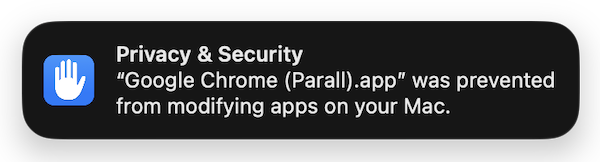
This message appears when macOS detects that a Parall-created shortcut is launching another app directly using its command-line path.
Parall does not modify apps or system files.
Shortcuts are read-only bundles that launch the target app with optional arguments and environment variables defined in their Info.plist.
You can safely dismiss this message. It simply informs you that the shortcut is attempting to start another app, which is exactly how Parall works to launch separate instances.
If you do not see the Open Anyway button in System Settings > Privacy & Security, try to launch the app shortcut once first. macOS displays this button only after the first launch attempt. Return to Privacy & Security after the attempt and click Open Anyway.
Alternatively, click Install script in Parall. After the optional script is installed, app shortcuts no longer require the Open Anyway step.
"App Management" permission prompts
On some systems, Parall-created shortcuts may appear in an “App Management” style permission screen with text similar to “Allow the applications below to update or delete other applications.” macOS shows this because the shortcut reads the contents of the original app bundle in order to launch it, so the system treats it as accessing another app.
Parall does not modify, update, or delete any other apps. Shortcuts only read the target app bundle and then launch it with the options you configured.
However, some apps use their own built-in self-update mechanisms. In those cases, the app may need App Management permission to replace or modify its own app bundle during an update.
For example, Viber may fail to install its updates when launched via a Parall shortcut unless this permission is enabled.
Recommendation: if the app you launch has a self-updater, choose one Parall shortcut instance for update checks and grant App Management permission to that shortcut when macOS prompts. In the target app’s own settings, disable automatic update checks for the other instances. After the update instance installs a new version, restart the other instances and they will use the updated app bundle automatically.
OAuth Authorization Limitations
If a shortcut instance requires external OAuth authorization, such as for Cursor or Codex, the authorization may fail if any other instance of the same app is currently running. To complete authorization successfully:
- Quit all other instances of that app.
- If authorization still fails, temporarily set Safari as the default browser in macOS and try the authorization flow again.
- After authorization succeeds, you can reopen and use multiple instances simultaneously afterward.
Note: If the app is sandboxed, custom home/data redirection will not apply during or after authorization. The app will continue to use its container.
Shortcut uses the same data as the original app
If you created a Parall shortcut for an app that is listed as compatible but it still uses the same data as the original app, the shortcut is probably not using the expected data separation configuration. Check these settings first:
- Open Parall and select the target app again.
- Confirm that “Data Storage Mode” is set to “Automatic”.
- Confirm that the shortcut has a unique “Data Storage Path”. Most apps require a unique data folder per shortcut to run as truly separate instances.
- If the app has app-specific compatibility notes on the compatibility page, confirm that the shortcut follows those notes.
If the app is still not separated after confirming these settings, please do the following and contact support:
- Quit the target app and the Parall shortcut.
- Right-click the Parall shortcut app bundle and choose “Compress” to create a .zip file.
- Email the .zip file to support@parall.app and include the target app name and a short description of what you expected vs what happened.
Removing Shortcuts
To remove a Parall shortcut, simply delete the shortcut’s app bundle as you would any macOS app, for example move it to the Trash or delete it normally. There is nothing to undo: activation modifies only the shortcut bundle itself, not the system or the original apps.
If you set a custom data storage folder for the shortcut, you should manually delete that folder as well.
After completing these steps, nothing remains from the shortcut on your system.
Still Need Help?
If something doesn’t work as expected - or if you’re unsure whether a behavior is intended - contact support. The app is actively maintained, and I’ll do my best to help.